
Why Connecting with This Genius Today Brings You the Ultimate Advantage
Hello.
I am truly delighted to meet with you today.
Do you have a few moments to spare right now?
I am incredibly grateful for this wonderful opportunity to talk with you about the most essential aspects of life.
Allow me to ask: Do you happen to feel a certain sense of emptiness in your current daily life?
Does your heart feel a little weary from the repetition of the exact same routine day after day?
Or perhaps you are experiencing an indescribable sense of gridlock in your work or personal relationships?
If so, this message has been prepared specifically for you.
What we are about to discuss is filled with powerful insights that can dramatically renew your daily life.
The central figure of our conversation is the legendary painter-monk who lived during the Muromachi period: Sesshu.
“Wait, what does a historical painter have to do with my life today?”
Did that question cross your mind?
That is a completely natural reaction.
However, let me make one promise to you right from the start.
Learning about Sesshu’s way of life and the astonishing messages he left behind will bring immeasurable benefits to your future.
Why? Because the hardships Sesshu faced and the methods he used to overcome them provide guaranteed wisdom that can instantly resolve the anxieties you face living in the modern world.
If you read this text to the very end, what kind of wonderful changes will occur for you?
First of all, the way you approach your daily work will change completely.
You will no longer be at the mercy of other people’s evaluations, and you will be able to discover your own unique, unparalleled strengths.
Furthermore, you will be liberated from daily stress, and a magnificent, absolute sense of peace will blossom within your heart.
For you, this will serve as a special, guaranteed ticket to achieving success as quickly as possible.
Now, are you ready?
This is not a difficult academic lecture.
It is simply a warm, heartfelt conversation between you and me.
Please relax, and kindly journey with me to the very end.
“An opportunity always presents itself at first as a crisis, or as a burden.”
—— Aizo Soma
Sesshu’s Tears That Awaken Your Talent: The Ultimate Psychology of Turning the Deepest Hardships into the “Best Opportunities”
First, allow me to share an astonishing story with you.
When you were a child, did you ever experience being severely scolded for doing something you were completely immersed in?
Sesshu, too, had such an unforgettable experience during his childhood.
Sesshu was born in the year 1420 in Bitchu Province, which is located in present-day Okayama Prefecture.
Around the age of ten, he was sent to Hofuku-ji, a temple belonging to the Zen sect, in order to become a monk.
However, the young Sesshu absolutely detested studying the Buddhist scriptures.
Why was that? It was because he loved drawing pictures so intensely that he simply could not help himself.
He constantly neglected his monastic duties and did nothing but draw all day long.
Eventually, the head priest grew furious and bound Sesshu tightly to a pillar in the main temple hall with a rope.
Unable to move a muscle, Sesshu felt so sad and miserable that tears began to stream down his face, dropping to the floor.
If you were in such a situation, what would you do?
Would you despair and simply cry continuously?
Sesshu was entirely different.
While still bound tightly to the pillar, he quietly began to draw a picture on the wooden floor with his big toe, using his own fallen tears as a substitute for ink.
The creature he drew at that moment was a mouse.
After some time, the head priest came back to check on him.
To his utter amazement, a large mouse was crouching right at the priest’s feet!
Startled, the priest moved his foot to shoo it away.
However, the mouse did not move at all.
Remarkably, it was not a real animal; it was an eye-catching, incredibly realistic drawing of a mouse that Sesshu had created on the floor with his tears.
Deeply moved by this magnificent talent, the head priest never forbade Sesshu from drawing pictures ever again.
Hearing this story, what do you think?
It would be a great waste to dismiss this as merely an ancient fable.
This is an incredibly important story that directly connects to your daily life.
Why was Sesshu able to draw such a brilliant picture under extreme conditions where his freedom was entirely stripped away?
It is because he focused his entire mind solely on “what he could do right in that moment.”
When troubles arise at work or when we feel isolated in human relationships, we often tend to curse our surroundings, wondering, “Why is this happening to me?”
However, doing so changes absolutely nothing.
The sheer tenacity to turn even your own tears into a weapon within the worst given environment—this is the only way to turn your life’s crises into dramatic opportunities.
If you currently feel burdened by your work, that burden might actually be a special message prompting you to transform into a completely new version of yourself.
“We do it precisely because it is difficult. I will do it because no one else does it, and no one else can. I might be a fool for doing so, but without such fools, nothing new would ever be born into the world.”
—— Kiichiro Toyoda
Great Success in Kyoto and the Luxury of Boldly Casting It Aside: The “Aesthetics of Subtraction” for You to Truly Shine in Your Work
Following the incident at the temple, Sesshu’s talent blossomed rapidly.
He later moved to Shokoku-ji, a highly prestigious temple in Kyoto, to begin his formal training.
Kyoto at that time was the absolute center of cutting-edge culture.
There, he met a wonderful master named Shubun, who was the official painter for the Muromachi shogunate and a leading figure of Japanese ink wash painting.
Sesshu studied ink wash techniques under Shubun with fierce dedication.
Before long, Sesshu’s name became so famous that absolutely everyone in Kyoto knew who he was.
To be recognized as a top-tier artist, to be pampered by everyone around you, and to have both wealth and honor within your grasp—if you found yourself in such a situation, what would you do?
Wouldn’t you be satisfied and think, “Excellent, my life is secure now. I’ll just stay in Kyoto, eat delicious food, and live comfortably for the rest of my days”?
Sesshu, however, was different.
He possessed absolutely no attachment to his status or fame in Kyoto.
Why? Because within his heart burned a powerful passion: “I want to cross over to China (the Ming Dynasty), the birthplace of this art, and learn authentic ink wash painting.”
The comfortable life in Kyoto was nothing more than “lukewarm water” that would eventually dull his soul.
Therefore, at the age of 48, Sesshu made the daring decision to leave everything behind, rely on the Ouchi clan in Suo Province, and board a perilous ship bound for Ming China.
What do you think of this astonishing decisiveness?
Living your modern life, do you ever find yourself settling for compromises, thinking, “Things are fine just the way they are”?
When things go slightly well, people often stop growing right then and there.
However, if you do that, you can never obtain the truly magnificent life you actually desire.
In order to grasp something new, it is absolutely necessary to courageously let go of the old things you currently hold.
Steve Jobs, a genius who changed the world, left behind a famous quote that I would like to gift to you right now:
“Quality is remembered long after the price is forgotten.”
How does this statement relate to you?
If you only focus on short-term profits or fleeting praise (the price) in your daily work, a truly valuable outcome (quality) will never be born.
Sesshu threw away the “fleeting praise” of Kyoto and set out on a journey in search of “authentic quality” that would be remembered for lifetimes.
Why not try cleanly forgetting about other people’s opinions or temporary losses and gains starting today?
Please try pouring your energy exclusively into the things you can truly pour your soul into.
The results will absolutely follow you later in an astonishing way.
“Having no talent and no art, I end up entirely bound to this single line.”
—— Matsuo Basho
What a Major Failure in China Taught Him: Your True Individuality Awakens When You Tear Up the Textbook
At the advanced age of 48—which was considered quite old at the time—Sesshu finally set foot on the long-awaited land of China.
He was fully prepared to learn the most advanced, authentic painting techniques and sharpen his skills by copying many wonderful masterpieces.
However, an incredibly unexpected twist in the story was waiting for him there.
As Sesshu traveled across various regions of China, he failed to meet even a single master painter who painted the magnificent works he had anticipated.
In Ming China at that time, uninspired, tedious paintings that merely copied outer forms without any soul were the prevailing trend.
Sesshu experienced a massive shock.
“I risked my life to cross the sea, only to find there is absolutely nothing here worth learning…”
If you were faced with such an unbelievable reality, what would you do?
Would you become discouraged and simply return home to Japan?
It was at this precise moment that Sesshu realized a beautiful truth:
“There is no meaning in copying old Chinese painting textbooks or imitating the paintings that happen to be popular right now. The true master is this great Chinese nature itself. The majestic mountains, the grand rivers standing before my eyes, and the people living there—all of these are my true teachers.”
Convinced of this, Sesshu grabbed his sketchbook and began to directly draw the rugged, wild landscapes of China exactly as he saw them with his own eyes.
Instead of perfectly imitating someone else, he chose to express the reality standing directly before him through his own soul.
This was the breakthrough that allowed Sesshu to establish a completely new realm of ink wash painting.
What kind of meaningful hint does this episode provide for your daily life?
We often find ourselves saying, “I want to be just like that person,” or “If I do exactly what is written in this business book, things should go well.” We try to copy other people’s success patterns exactly as they are.
Yet, for some reason, it rarely works out.
Why is that? It is because “your own soul” is missing from it.
No matter what kind of marketing you use, you can never make a poorly made piece of work a true hit.
Your existence itself is the ultimate original masterpiece.
Please stop trying to be a copy of someone else.
See the world through your own eyes, speak in your own words, and do your work in your own unique way.
Only there can you find the path to achieving success as quickly as possible.
Just as Sesshu learned the core essence of art from the great wilderness of China, please find your own answers from the reality that stands directly in front of you.
“There is no life within life; true life is found within death.”
—— An Ancient Proverb
A Grand Resurrection from the Despair of the Onin War: The “Power of Continuity” That Saves You After Everything Burns Down
After completing his fulfilling two-year journey, Sesshu returned to Japan in 1469 with great expectations.
However, the news waiting for him upon stepping off the ship was incredibly cruel.
The beautiful city of Kyoto that he loved so dearly had been completely burned to the ground and turned into a wasteland by a massive civil war known as the Onin War.
Shokoku-ji Temple, where his master had lived, and the homes of the people who had cared for him were all reduced to ashes.
In a single instant, he had lost the place he was supposed to return to.
Can you imagine the overwhelming sense of despair when everything you have desperately built up until your late 40s suddenly becomes zero?
If you were to suddenly lose your company or the precious family life you have built, would you be able to stand up again?
Sesshu absolutely refused to give up.
If Kyoto was ruined, he would simply go to the provinces.
Out of necessity, he became a wandering painter traveling all across Japan.
Oita Prefecture (Bungo), Shimane Prefecture (Iwami), Gifu Prefecture (Mino), and Yamaguchi Prefecture (Suo)—wherever he went, he continued to create works by blending the powerful methods of depicting nature he learned in China with the delicate sensibilities of the Japanese people.
No matter where he found himself, he focused entirely on drawing pictures using primarily the gradations of black ink.
What was it that sustained him through the loneliness of a war-torn world and the isolation of not knowing when death might come?
It was a tenacity toward drawing that could almost be described as madness.
Astonishingly, among Sesshu’s surviving works today, a total of six are designated as National Treasures—the highest number for any individual painter in Japanese history.
Furthermore, every single one of those masterpieces was painted after he reached his mid-60s, during the final years of his life.
His creative passion never diminished in the slightest until the very moment his 87-year life came to a close.
Isn’t that absolutely unbelievable?
Many people make excuses as they age, saying, “I’m not young anymore,” or “It’s too late to start something new now.”
However, when you look at Sesshu’s life, you realize that such thoughts are merely a form of self-indulgence, don’t you agree?
The peak of your life is actually yet to come.
No matter how difficult your current situation may be, keep continuously doing what you need to do every single day, just like stacking bricks one by one.
In return, you must give it your absolute best effort.
God ultimately grants a magnificent reward only to those who refuse to give up and keep moving forward.
“Most people think of success as something you get. But in reality, success is about giving.”
—— Henry Ford
“Art Collecting” as the Ultimate Investment to Enrich Your Life: Why Bringing Sesshu Closer to You Elevates Your Happiness
At this point, allow me to share a very concrete benefit meant directly for you.
Do you happen to believe that appreciating art or hanging paintings in your room is an exclusive hobby meant only for the wealthy?
That is a major misconception.
Engaging with excellent works of art is actually the most efficient investment you can make to maximize your happiness in life.
Why? Because excellent art possesses a powerful ability to instantly renew your day and wash away your stress.
In particular, ink wash painting, which relies primarily on the gradations of black ink, is the very expression of the Zen spirit.
When you gaze intently at Sesshu’s paintings, don’t you feel a strange sense of serenity, as if the noisy chatter inside your head is quietly fading away?
The feudal lords and wealthy merchants of the Muromachi period also eagerly sought Sesshu’s paintings and cherished them in their collections.
They did not buy these paintings merely as luxury items.
Amidst days of fierce battles, they absolutely needed Sesshu’s art as a tool for mental control—to heal their exhausted minds and prepare themselves to win the next battle.
This applies in the exact same way to you as you fight your battles in today’s intense business society, doesn’t it?
If you ever feel weary from your daily routine, please take even just a single moment to touch something beautiful.
By decorating your room with a single, magnificent painting, you can instantly transform that space into your own private, sacred sanctuary.
On busy mornings or exhausted nights, that painting will greet you gently, offering a silent standing ovation in its heart just for you.
Surrounding yourself with high-quality things elegantly elevates your self-image.
Valuing yourself and giving yourself the finest, first-rate things—that is the most reliable step toward elevating your life to the next level.
“The softest thing in the universe overcomes the hardest thing in the universe.”
—— Laozi
The Law of Success Demonstrated by Toyota, Honda, and World Leaders: “Never Look Away”
Let us shift our perspective to the modern era for a moment.
The episodes of the great pioneers who built Japan’s manufacturing industries sync up with Sesshu’s way of life in an astonishingly beautiful way.
Are you familiar with Sakichi Toyoda, the founder of the Toyota Group?
He was treated as an eccentric, an “invention maniac,” and a madman by those around him.
From morning until night, day after day, he did nothing but build something, tear it down, and build it all over again.
Why was he capable of doing such a thing?
It was simply because he possessed an unyielding tenacity and patience driven by a single desire: “I want to invent things that make everyone’s lives easier.”
His son, Kiichiro Toyoda, inherited that exact same passion, famously stating, “I will do it because no one else can. I might be a fool, but without such fools, nothing new would ever be born,” and went on to build Japan’s automotive industry completely from scratch.
The same can be said for Soichiro Honda, the founder of Honda, and Takeo Fujisawa, the brilliant partner who supported him.
Soichiro Honda dedicated his life to technology, never looking away as he continuously built engines, while Takeo Fujisawa focused entirely on managing the business.
Furthermore, Shotaro Kamiya, who was known as the “God of Sales” for Toyota, and Taizo Ishida, who fiercely protected the company with stubborn integrity, were all individuals who dedicated their entire lives “solely to their work.”
For these men, there was no time to go out for fun or enjoy leisurely hobbies.
They simply worked harder and longer than anyone else. That was their baseline.
In the history of Choya Umeshu, there is also this fiercely intense declaration:
“If you cannot succeed with plum liqueur, give up on life entirely.”
Betting everything on a single path.
Never looking away.
Decide instantly, act instantly, execute instantly.
If you just try doing it, results will always appear.
The very first step is simply to do it.
If you wish to succeed at something today, don’t you think it is incredibly worthwhile to emulate the absolute, laser-like focus of these first-rate men?
Dabbling in various things only scatters your energy.
Find the single path that makes you say, “This is it,” and bet your entire life on it.
When you do, an astonishingly new world that no one has ever seen before will surely open up directly in front of you.
“I am merely doing my duty to fulfill the task assigned to me by God.”
—— Jean Calvin
Art as the Salvation of the Soul That Cuts Deeply into Your Heart: Why We Continue to Express Ourselves
We have shared many stories today, but let us now touch upon the deepest part of our hearts.
What is the thing that holds true value for you?
Things that bring immediate results or are easily obtained tend to vanish just as quickly.
Things of true value are, more often than not, things that lack immediate efficacy.
Whether in art or in business, things almost never go perfectly right from the very start.
What truly matters is to continuously offer the finest service for the sake of “you,” who stand right in front of us, no matter how misunderstood we may be by the rest of the world.
Akio Morita, the co-founder of Sony, once said that when you create a completely new product that no one has ever seen before, it cannot truly become a commercial product unless you awaken a desire within people to possess it.
Communicating the value of a good thing is absolutely vital.
If it is not communicated, it is exactly the same as if it does not exist.
Sesshu sought to communicate the beauty of Japanese nature and the truth of Zen to people using nothing but the gradations of black ink.
And today, there is a certain artist who has inherited that exact same spirit, attempting to serve you with his entire life through a completely new approach.
Life is never determined by where or how you were born and raised.
No matter how lonely you may feel, or how isolated your environment may be, you can journey toward absolutely any future you desire through your own diligence, patience, and power of continuity.
The fact that you are reading these words today is by no means a mere coincidence.
I believe from the bottom of my heart that your life will begin to shine even more beautifully and powerfully from this moment forward.
First, rather than overthinking, please just try doing it.
Please do not give up easily.
Everything is going to be fine; you will absolutely succeed.
“We are hard pressed on every side, but not crushed; perplexed, but not in despair; persecuted, but not abandoned; struck down, but not destroyed.”
—— The New Testament, 2 Corinthians 4:8-9
“You cannot leap to the summit of Mount Fuji in a single bound. You must climb it step by step. Each and every step is, quite naturally, painful. However, if you climb to the very top, a magnificent view awaits you.”
—— Osamu Dazai (From Justice and Smiles)
Postscript: A Lifelong Message from Mimi Takamizawa, the Seeker of Digital Ink Wash Painting
Lastly, please allow me to speak briefly about a very precious friend of mine.
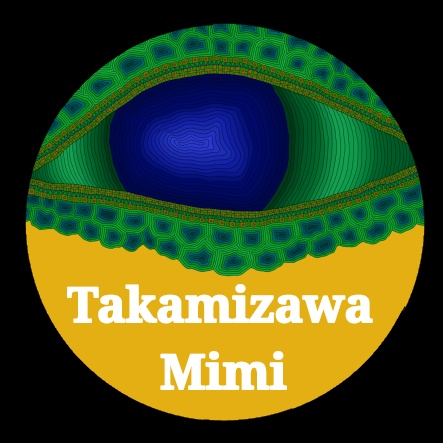
There is a unique, highly eccentric, yet deeply lovable painter named Mimi Takamizawa.
He might surprise you, but he does not use a canvas or a paintbrush at all.
He creates all of his artwork digitally, and then finishes each piece by printing it onto the highest-grade printmaking paper using the giclée technique—the absolute pinnacle of fine art printing.
“Since it’s digital, it must have less value than a hand-painted picture.”
If you happen to think that way, please listen to his story and feel free to laugh at him.
The themes Mimi Takamizawa depicts are entirely unwavering:
“Your eyes, my eyes,” “Christianity,” “eternity,” “psychology,” “truth,” “the gaze,” “history,” “loneliness,” “isolation,” “hardship,” “resurrection,” and “liberation.”
Why does he so stubbornly continue to paint “eyes”?
It is because, within his art, he wishes to continuously feel “you,” who stand right in front of the piece.
He wants to know you.
He wants to save your soul.
He genuinely believes that “a painter is a doctor who saves the soul.”
Mimi Takamizawa resolved to become a painter after learning about the fierce, tumultuous life of Vincent van Gogh.
The name “Mimi” (which means “ear” in Japanese) in Mimi Takamizawa was chosen in honor of Van Gogh’s famously tragic ear-severing incident.
During his lifetime, Van Gogh was supported by his brother Theo and Theo’s wife, Jo, yet he passed away in deep loneliness without selling a single painting.
Following Theo’s death, Jo made it her life’s mission to ensure that Vincent’s work was seen by many and that its true value was recognized, successfully spreading Van Gogh’s art to the entire world.
Van Gogh left behind this beautiful, famous quote:
“I want to express something comforting in my pictures, as music does.”
Mimi Takamizawa holds this quote tightly to his chest as he lives. He knows all too well that a work of art has absolutely no value if it cannot move anyone’s heart or bring comfort to a single soul.
Mimi Takamizawa holds Tokuji Munetsugu, the founder of CoCo Ichibanya, in the absolute highest esteem.
Mr. Munetsugu grew up without ever knowing the faces of his biological parents, spending a tumultuous childhood in absolute, isolated poverty.
He had so little to eat that he resorted to eating wild grass in the summer to survive starvation.
Yet, once he started his business, he never looked away for even a single moment, dedicating his entire existence to his work.
During his time as CEO, he completely sealed away his beloved classical music, cut off all hobbies, friends, and nights out, and worked up to 5,640 hours in a single year.
“It was an incredibly lonely life. That is why I wanted people to show even just a little interest in me. Rather than making money, I simply wanted to make people happy. I wanted someone to say they were glad I existed, even if just a little bit.”
These words by Mr. Munetsugu are the exact echo of Mimi Takamizawa’s own soul.
An artist’s work, for Mimi Takamizawa, is a form of putting his own skin in the game to provide the ultimate service directly to you.
It is an absolute devotion to you.
He offers everything he has to you, who stand right in front of him.
He knows perfectly well that all past masterpieces were not born from effortless genius, but rather from decades of trial and error, combined with a fierce tenacity of working over 12 hours every single day.
Therefore, without looking away, he continues to paint pictures today solely to comfort your heart.
Please, feel free to laugh at his desperate act of being a jester for you.
He grows stronger by being laughed at.
No matter how lonely he may be, or how isolated he becomes, he will absolutely never abandon you.
Why? Because he loves you.
“Our greatest weakness lies in giving up. The most certain way to succeed is always to try just one more time. Many of life’s failures are people who did not realize how close they were to success when they gave up. My success is due to my continuing when others have given up.”
—— Thomas Edison
Our conversation for today concludes here.
I am deeply grateful from the bottom of my heart that I could share such a wonderful space and time with you.
I look forward to the day we can meet again with bright smiles on our faces.
Please, have an absolutely wonderful day.